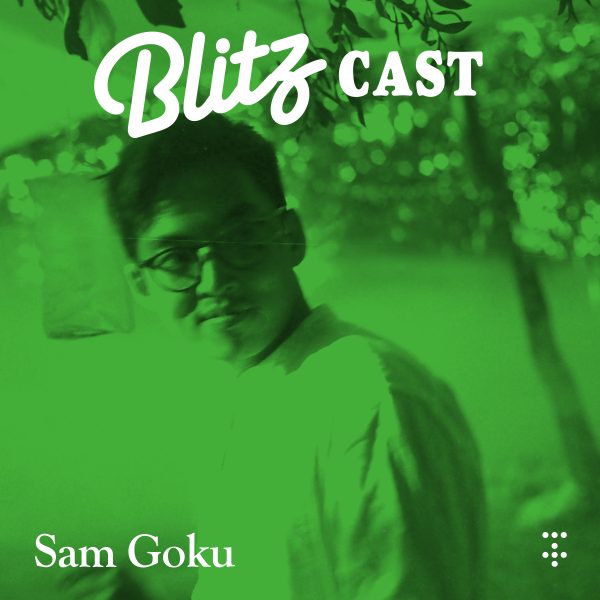
Munich-based DJ & producer Sam Goku has slowly and steadily built his own colourful, genre-defying microcosmos, with releases on Permanent Vacation and Dekmantel, as well as eclectic mix series such as Club Random and Yellow River.
A frequent presence in our Blitz booth, he now returns ahead of his forthcoming release Yulun, out Friday on our friends Marie Montexier’s imprint, Paryìa. We’re pleased to share a new Blitzcast from the multifaceted selector — and to catch up on his past, present and plans for what’s next.
Make sure to follow him on the socials to keep up to date with his upcoming releases, gigs & reflections:
soundcloud / instagram / bandcamp
Listen to his Blitzcast, Nr. 030 right here while you dig into the interview:
Hey Robin, let’s start with the present: what was the last piece of music that genuinely surprised you?
i was surprised by oklou’s album choke enough and by how modern pop music can still excite me.
Three words to describe Sam Goku. No genre tags allowed. You’ve been active long enough now that there’s a certain expectation attached to your name & profile. Do you feel that? And if so: where do you take it?
rooted, fluid, vibrant. i do feel a certain expectation attached to my profile but i feel that it comes more from myself than from anyone else. one of my biggest fears is that single pieces of work don’t fit into the puzzle. one of the biggest challenges of my ‘artistic journey’ is to set myself free from that and to deeply trust the process – that everything that i make from the heart will be worthy.
How did music first enter your life? At what point did production become more than curiosity?
Was there a specific moment when you realised dance music could be a language rather than just a function?
music has been part of my life as long as i can remember. my mom sings a lot at home and my parents used to bring me to karaoke bar nights with their friends from when i was a toddler. i listened to them sing chinese ‘popular songs (流行歌曲)’ and traditional songs until i fell asleep on one of the couches and after hours was carried back home. these melodies are deeply ingrained into my consciousness.
i first learned about ableton when i moved to munich for my studies. my roommate back then was at that time producing music and touring as a dj. i remember receiving a beginner’s lesson from him and from that moment on i rarely spent a day without opening ableton. dance music always was connected more to feelings than to function for me – it was actually later in time that i understood the functional aspects of dance music more and more, so for me it was almost the other way around. even though my first productions were inspired by experiences in clubs, the functional aspect wasn’t central and it didn’t work particularly well on dancefloors. the past years have been about figuring out groove and energy and what works for bodies and clubs, but lately it’s the emotional sides of dance music that’s been striking me again.
You work within recurring frameworks with many of your mixes: Club Random and Yellow River Radio at Radio 80000.
What do these recurring structures allow you to explore that a club night doesn’t? If those formats didn’t exist, how would your recent Blitzcast have sounded differently?
that’s a great question. the club random series started as a place where i could explore different facets of dance music, often mixed within a single set. it almost feels like a classic radio show format, where i showcase my recent favs (new and old), but structured and mixed the way i would play them at a club night. yellow river radio is where i can feel free to play literally anything that i like. there is all this music that touches me all on different levels and in different ways. if those formats didn’t exist i would probably feel that i had to showcase at least hints of all that in my blitzcast, but this way i could focus more on a certain vision that i had for the mix.
You mentioned your Blitzcast reflects recent influences and approaches. Was it meant as a snapshot of where you are? Or perhaps as a statement of where you’re going? And how did the idea of Blitz (the club, the crowd, the system, the programming, etc) inspire the Blitzcast?
yes, the mix is pretty much a snapshot of where i am right now. i wouldn’t call it a statement as the word feels a bit too firm for the fluidity at which things move. blitz is certainly the club whose front door i’ve walked through most often. it has informed me and shaped me as an artist. for me it is the technical aspects of the club that are the most formative for me. the sound system has shaped the way i perceive music down to things like mixing decisions i make for my productions. for example, i have learned (or rather experienced) at blitz that for dance music that has a certain emotional impact for me, the mids need to have weight and focus. i used to believe that everything needs to be bass-heavy but with the warmth and weight of the sound system at blitz, my perspective shifted. for the blitzcast i envisioned the warmth and energy of the main floor, relatively minimal grooves – let the room do the rest 🙂
Aside from your regular mix series, there’s also a string of conceptual releases from you: From Glistening Club Music to the recent Explorations series. It’s clear you have a penchant for structures: tell us more about your fascination and relation with these and how you work with them.
When E.G.; you start a track, do you begin with a concept, or does structure emerge retrospectively?
it’s less the fascination with order, it’s more that i need it to structure my releases in a way that feels good to me. there is just so much stuff that inspires me, that sometimes i feel the need to open another category/concept for works that were created in a certain ‘era’. for example the music on glistening club music was heavily influenced by the experimental characteristics of uk house and techno. with explorations i am returning to a sound that in my own words feels more grounded and familiar. when i think about it, lots of the categories in my head are rather connected to feeling than to genre. it’s similar when it comes to music production. nearly all my productions emerge from a feeling that inspires me (mostly musical experiences and sometimes things that happen in life), almost never from a concrete idea.
We know that you work with a fairly minimal technical setup for productions: Ableton & a midi-keyboard. Whereas you worked with direct samples and elements of Chinese culture, you now channel this spirit through feeling and flow, mentioning flowing movements and transitions.
Let’s take a closer look at this: what gestures, techniques and approaches channel a Chinese spirit? If you remove samples and explicit markers, what does a “Chinese spirit” in music actually mean to you?
when i was a kid, my grandparents had a patio in china where i would sometimes playfully mimic the movements of chinese wushu (or kung fu) with its slow, flowing, wide-ranging sequences, that are occasionally punctuated by sudden thrusts. for me this kind of movement is something that recurs in chinese culture, in the language, calligraphy, in poetry, maybe in mentality even. i try to translate this kind of movement into certain elements of my sound. there are also other markers for me like timbre and texture. of course most of electronic music that i grew up with comes from europe or the us and i am sure there are so many influences from all around the world that somehow find their way into my music in a way that i am not conscious about, so in the end it’s a mix of all that.
Personally, I’ve always admired the sanguine and refined character within your sets, mixes and productions, across a wide range of styles, moods & tempo ranges. I can’t help but wonder: what would Sam Goku sound like with a sonic sledgehammer? Have you ever tried working on something deliberately excessive, perhaps?
that’s a good question! right now, i wouldn’t know how to approach this but it would be a fun experiment for the future. i definitely would want to keep the sanguinity because that’s just how i am but maybe with a more ‘in your face’ approach. i feel like this might be reserved for a later stage in life haha.
You’re remarkably open on Instagram about the reception of music & clubs, creative self-doubt, the emotional dimension of narratives and many more topics.
What observation is currently occupying your mind?
i’m observing that there are so many different people with so many different histories and realities. what i am trying at least is to understand everyone as equal and treat them with respect, even or especially if their worldview or opinion is painfully opposed to mine. at least i feel like this is the only way we can turn pain and anxiety in today’s world into something more positive.
You mentioned you’re going to launch your own imprint too, not only as an expansion of your language, but to be free about the direction of your own productions. Freedom from what exactly? Curatorial compromise? Timing? External expectations?
Will the imprint reflect a different side of you or explore a more detailed aspect of the Sam Goku we already know? Are you planning to invite other artists too? We’re curious to hear about your plans!
whenever i start a project, one of the problems that keep occuring is that i rarely manage to be completely free of the voice in my head that tells me how things would sound like if i made something for this or that label. on the best days i almost don’t have these thoughts at all and these days are the days of my best work. i do feel great freedom with the labels i work with because i would say that there is a lot of trust in the relationships but i still can slightly feel the element of expectation. i’m sure that i can’t eliminate expectation entirely, even with my own label but i also feel like there is something else that i would like to bring to the world and the time feels right.
Have you thought about creating your own event format as well, something that translates your structural thinking into a physical space?
yes, i have thought about it but those ideas are a very early stage.
You’ve played Blitz multiple times. What was your most memorable experience there and what was the most unexpected one?
How does playing in Munich feel compared to elsewhere?
the last time i played at blitz was my favourite and most memorable time. i played the opening set and felt at ease for the whole set. it marked the first time after a longer period, where i didn’t play at blitz but felt like i learned a lot during that time. there was a palpable difference in feeling after the break and being able to bring this new feeling to blitz made me very happy.
Looking ahead to 2026, what else can we expect from Sam Goku?
Are you moving toward a clearer focus in sound or perhaps a more multifaceted exploration?
at the moment i can feel a clearer focus – not necessarily in terms of direction but rather in the way i am approaching my goals. i still want to be able to make anything i like without having to worry whether it meets anyone’s expectations and it feels like i’ve definitely gotten closer to the peace of mind that allows that. i am constantly working on new music – some of which is going to be out on some of my favourite labels. then of course my own label – things are moving slowly but steadily here. i wanna say that i want to keep expanding my sound but i’m happy to work with whatever the universe will throw at me creatively.
Last questions!
What piece of music, an album, live show, mix, or otherwise, has moved you recently, beyond the realm of self-promotion or networking?
when i was in japan last year, i listened to carrier’s RA mix on a long bus ride. i feel like the mix has revived my love for minimal, textured soundscapes. i even wrote a bit that captures the thoughts and feelings i had while listening to the mix and posted it on instagram.
And finally: if someone listens to Sam Goku ten years from now, what do you hope they hear: evolution, consistency, or something entirely different?
i hope they hear the same essence 🙂