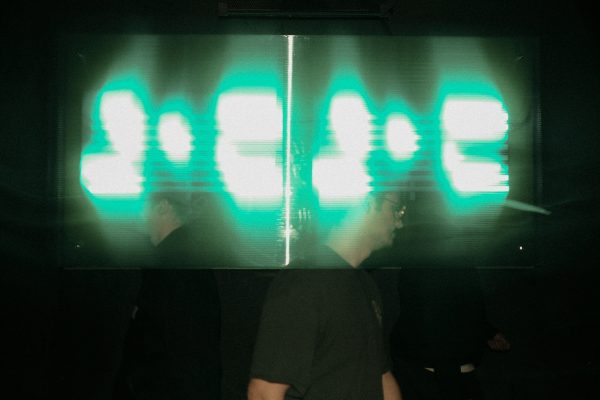


„It looks a bit like something from Blade Runner. […] with the added chance to get lost in a pixel void.“: Luis & Oli, Studio Omo
Studio Omo’s visual installation has been gracing the lower of our two bars since October 2025. Just ahead of our closing party, where the duo will also prepare a new lighting piece for the Bistro floor, we sat down with Luis and Oli to talk about their practice and the inspiration behind their work displayed at Blitz Club.
The closing weekend will be your last chance to catch the installation before we say goodbye.
Find out more about Studio Omo on the web: https://studio-omo.com/ or on the socials: https://www.instagram.com/studio.omo/
********************
Let’s begin with the name, with etymology: Where does “omo” come from, and how did it become the name of your studio?
Luis: The name ‘omo’ has gained different meanings for us over time. When we first came across the word, we associated it with the idea of a cycle, and we found that idea really fitting, because back then we were thinking about starting an event series that would happen at regular intervals, something that could return, evolve and create a continuous process.
We were also looking up the word in different languages to see if anything would inspire us. That is how we ended up with Yoruba, a language spoken in West Africa. To be honest, we got the translation wrong at first and thought it confirmed our idea of the word ‘cycle’. It actually translates to ‘child’. Looking back, I think that meaning is much closer to the way our studio has developed anyway. Our practice is strongly driven by curiosity, experimentation and a playful approach towards materials, space and technology. There is something childlike in the way we work, as we are constantly exploring, testing and discovering new possibilities.
How did the two of you end up working together?
Oli: We met behind the decks at an illegal outdoor event in the woods about seven years ago. At the beginning, we worked together with more people on different projects, but over time the studio naturally evolved into the two of us.
Through different projects, studio omo gradually developed from event-related ideas and DJ livestream formats during the pandemic into a practice focusing on scenography, lighting design, audiovisual installations and music. Our love for music and design has always remained the common thread connecting everything we do. Additionally, I have some insight into music production and Luis a degree in architecture.
Walk us through what’s actually on that wall and let’s start with the material, not the concept. What are people looking at?
Luis: The installation features a set of LED bars, Makrolon panels, a custom rigging system we built for the bars, and a Raspberry Pi that controls everything.
The idea was to create three surfaces that behave like analogue screens. We positioned the LED bars very close to each other, which gives you an almost pixel-like, low-resolution image. The Makrolon panels in front of them then diffract and distort that light depending on where you are standing, so the way the installation looks keeps shifting while you move through the room.
The build itself went pretty smoothly; it just required a lot of precision. For me, it’s the simplicity of the materials that lets the interaction between light, surface and perception become the main element.
And now to the concept: What was the main inspiration behind the piece?
Oli: Luis and I have a shared love for analogue things, whether it is synthesizers or lights. In one of our very first projects, we worked with a bunch of CRT TVs and loved their vibe, apart from the horrible high-frequency humming. We wanted to explore that CRT aesthetic with our LED bars, so we built a custom rigging that allowed us to put the bars together to panels that act almost like low-resolution screens.
The problem was that the light still came across a bit digital, even though we were going for something retro-futuristic. To solve that, we thought it might be interesting to pick up an idea from our earlier work, where we let light pass through water to then catch the light reflection. Working with water can be very tedious and would require a lot of maintenance.
One day Luis brought up the idea of letting the light pass through a filter that behaves similarly to water but is easier to handle. So we started looking for a material that could do that. At some point we stumbled upon Makrolon panels and combined them with our LED bars. That opened up an entirely new world for us. It wasn’t like the water before, but it was an even better match, and for us the ideal material for the installation at Blitz. Especially because it blends in well with the analogue main lights on the Blitz floor. You get a light source that is always there without ever disturbing anyone, and the diffusion changes depending on where you are standing in the room.
Most of your installations come with a purpose-built musical score. This one is actually up against whatever’s actually playing at Blitz Club: a resident one moment, an international DJ the next, and at times even experimental live music & screamo. What did you design for, not knowing the soundtrack?
Luis: The installation is located in the bar area, which is somewhat separated from the main club space, so we were interested in creating something that can exist somewhat independently from the main club dynamics.
It is not directly connected to the energy of the dancefloor or the DJ booth, but you obviously still hear the music from the bar.
For me, the installation creates its own atmosphere and its own rhythm. Since it is separated from the crowd on the dancefloor, I think it develops a different kind of presence, a quieter and more meditative experience that still coexists with the overall atmosphere of the club.
How much of that range of music did you actually design around, and how much did you decide wasn’t your problem to solve?
Oli: Knowing that we cannot influence the acoustic environment, we decided we needed an installation that could fit in with any kind of musical context. Our piece intentionally features segments that are visually faster, and others that are more calm or slower.
We thought it could be interesting to expose our installation to the given sound and, vice versa, expose the given sound to the light installation. This allows for continuous contextual change and a somewhat ever-changing experience. The goal was never to visually translate the music, but to let the two enter into a dialogue with each other.
Let’s talk about its placement, removed from the dancefloor. What does the bar need from light that the dancefloor doesn’t?
Luis: A space where people stay, talk and take a break naturally requires a different light setting than the main club area.
I had been to Blitz plenty of times before and knew the bar as a guest, but I never really spent much time in that part of the club. I would usually end up outside instead. Since the installation is there, I obviously sit down in that corner a lot more often.
Compared to the dancefloor, the brightness and intensity are much more restrained. At the same time, the installation still needs to remain engaging and cannot just become background lighting.
That is why we programmed a whole range of patterns and colour variations that keep creating new visual situations. We did all of that on site, by the way. Programming it in the studio was pointless; the colours, the programme itself and especially the brightness only made sense once we could judge them in the actual room. People sitting at the bar can observe them and dwell in a state that is engaging and regenerative at the same time.
Before our installation, I always felt that the green panels emitted a bit of a vibe of emptiness. Now the bar visitor has the chance to immerse into that light ambience, with the added chance to get lost in a pixel void.
Does it read differently at 11pm than at 4am?
Oli: It depends on what you mean by that. If you’re asking if the lights are different at 11pm compared to 4am, I can tell you that, with the given environment and our means, we have recorded a 30-minute light programme loop that is ever repeating. That being said, the likelihood of a guest noticing the loop is very slim, as every angle provides a different kind of experience as the light breaks through the Makrolon, which seems to be position-dependent. Don’t pin us down on it, we are no physicists. But it would literally require 30 minutes of continuous observation from one specific angle to notice the programme loop. In my experience observing how I noticed the piece, I had the feeling that I mostly encountered the piece when passing by. Doing so, I always had different visual experiences. The longest I looked at it was maybe 5 minutes when having a drink, and then it became a less dynamic but more meditative experience. So I guess what I’m trying to say is it does not really read differently at 11pm or at 4am, yet throughout the night the vibe changes: maybe you sit more to the left or to the right at the bar, your angle changes, consequently the experience changes.
Luis: The lighting conditions themselves do not really change, because the installation is indoors, but I think the way people perceive it changes throughout the night.
At the beginning, many visitors are focused on arriving, finding the dancefloor and experiencing the main event. The installation might not immediately catch their attention.
After spending more time in the space, sitting at the bar or taking a break, people maybe start noticing that it has its own rhythm and that it changes depending on movement and perspective.
The first time Oli and I saw the installation during an actual club night was during the 30 Years Liquid Room night with Jeff Mills. Seeing it there in the middle of a busy room was pretty surreal. It fit the night really well, and having something of ours permanently in a club felt like a big step forward.
For me, that is the moment where it becomes less of an object you actively look at and more of an atmosphere that slowly reveals itself.
You’ve called reflection central to the studio’s practice. With a different set every weekend, is the piece still reflecting something specific or has it become more like wallpaper that repeats?
Oli: Reflection is deeply rooted in our ideas and concepts, and so is repetition. I don’t even mind thinking about it as a futuristic version of a wallpaper. I said it even to Luis when we set it up: it looks a bit like something from Blade Runner. I really think it gives the bar area a more lively feel.
If you had to name one actual track or one kind of night this was built for, what would it be?
Luis: I think the installation was not built for one specific track, but rather for certain transitions within a night. What interests me are these moments between different states, leaving the intensity of the dancefloor, taking a break at the bar, observing the space and slowly becoming aware of the atmosphere around you.
The one night that comes to mind is the Blitz anniversary party this year. I spent the last ten or fifteen minutes of DVS1’s set at the bar, just to take a moment. The panels, the light and the sound coming through from the other room all came together in a way that fit really well.
In that sense, it is less about a specific genre or song and more about the flow of a night, about how energy turns into calmness and movement into stillness.
Cymatics, making water visibly vibrate, is essential to a whole range of previous pieces from studio omo. Was it an idea for Blitz too? What ruled it out?
Oli: We definitely thought about integrating cymatics into the installation, especially because the staircase area at Blitz gets beautiful natural light during daytime events, which could have worked really well with a cymatic piece.
The problem was that there are restrictions on where you can install things. We were told early on that the other tenants use these areas too and would not be happy about things being set up there, which is totally understandable. On top of that, most cymatic setups we have worked with require water, which makes them very high maintenance. And there is a good chance that the bass inside the club would influence the whole thing significantly. Honestly, there were just too many challenges in integrating a cymatic piece into the club environment for a longer period of time.
Eventually we were told we could do a temporary installation in the bar area instead. From there it was pretty clear that we wanted to change the ambience of that room with light, which also works much better in a club context.
Has anything about how people actually use and view it surprised you? After all, the installation is next to a bar, not a gallery. Drinks get spilled, people lean against it and a lot more.
Oli: Mhm, not that I specifically remember. On some occasions I watched people interact with it, and in those situations they always seemed fairly observational, like they were having an introspective moment. Then again, we are no strangers to club environments and we know how people tend to behave in a club. That definitely went into how we built it.
Luis: What I find interesting is that the installation does not demand attention in the same way a piece in a gallery would. People might not immediately stop and analyse it, but after spending some time at the bar, they start noticing the changing patterns, the reflections, the movement.
I actually like this kind of subtle interaction. The installation becomes part of the environment rather than an isolated object. It can be something people actively look at, but it can also just become part of how they experience the space that night.
The fact that it is placed in a club was an important part of the design process. We were never interested in creating something untouchable or distant, but in something that can exist alongside people, movement and the unpredictability of a night out. So far the only real trace anyone has left on it is a piece of chewing gum someone stuck to it at some point. Apart from that, it is still in good shape.
Something I do quite a lot is ask friends what they think of it, especially the ones who have not been to Blitz that often. I tend not to mention that we built it, simply because I want an unbiased reaction haha.
A piece in a gallery is the main point of attention. This installation is part of a framework for somebody’s Friday night. Most people won’t register it as art at all.
Does that change how you design, knowing there’s an audience that isn’t really looking?
Oli: Of course, and I think we touched on this before. The piece can basically work as an ambient light that people only really perceive when they pass by. If they sit down for a drink at the bar, it might become the thing they drift into for a minute, or they might not notice it at all. There is a certain thrill in that. Something you have built is exposed to people who came out to party, not to your average gallery visitor. The only real influence it had on our design was that we made it sturdier, so it could cope with a club environment over a longer period.
You’ve also worked with other clubs in Munich. Does studio omo’s approach change from room to room, or are you building one narrative across Munich’s clubs?
Luis: It is honestly both. We always try to develop installations specifically for the place and the situation they are made for. Every club, every room, every context comes with different requirements, and we respond to those conditions rather than dropping a finished idea into a space.
What we are really committed to is the idea of scenography, where the task becomes to transform a room by changing parameters that influence it to eventually create a new scene or vibe that is not necessarily related to what the room felt like before.
At the same time, there are certain principles and interests that keep showing up across our work. We have done a lot of parties at Rote Sonne with Surge, our own event series that we host together with a few friends. With studio omo we develop the complete lighting concept and scenography. One of our first off-location events was at the Blackbox in Gasteig, where we did the entire lighting and stage design. It was one of the biggest things we had done at that point and quite demanding: we suspended nine LED rods from the ceiling, plus a lot of other light elements throughout the space. A lot of work, but absolutely worth it.
Honestly, that is how most of these projects go. You plan for weeks and then everything happens in the last few hours before doors, and something always fails. We definitely overreached with the Blackbox, but those are the projects you learn the most from. That one moved us forward more than anything we had done before.
For me, moving back and forth between commissioned work and our own events is what keeps it interesting. We get to test something, refine it, expand on it, and then adapt it to a very different environment.
How do creative decisions get made between the two of you?
Luis: The process is based on constant exchange between the two of us. Depending on the project, developing a final idea can be a longer process of discussing, testing and refining different approaches. Sometimes we agree within a day, sometimes we each come up with a completely different concept and then weigh them against each other for some time. And sometimes we do not get anywhere for a while. At some point one of the two ideas just starts making more sense to both of us, and what comes out of it is usually something neither of us would have arrived at alone.
Oli: Usually one of us takes the lead in developing an initial direction, and then we continue building on that idea together. For example, for the installation at Blitz, I had the idea to use our LED bars in a panel arrangement and Luis found Makrolon as a material for diffusion after we had already given up on the water idea. Either way, the final result is always a collaborative effort from both of us.
What’s next for studio omo?
Oli: If we knew what’s up next, things might start to get boring. Jokes aside, we have a lot of ideas and are really looking forward to bringing them to fruition.
The most immediate one is the closing party at Blitz, where we are taking on the light and space concept for the bistro floor. A whole room to rework with light
and an installation. Honestly, we are extremely hyped about that one.
Now to our last question: What piece of music, an album, live show, mix, or otherwise, has moved you recently, beyond the realm of self-promotion or networking?
Luis: One experience that really stayed with me was Zunder Festival in Innsbruck, an experimental music festival. I saw a lot of artists there, but the sets by Aho Ssan and Exploited Body stood out to me the most.
Both performances had such a strong and individual approach to sound. It reminded me again how broad music can be and how many boundaries are still there to be pushed. Experimental music is becoming more present, but it is still a fairly niche field, which for me makes experiences like that even more valuable.
I also wanted to mention the album Music for Existing by Martyn. What stayed with me is how open and organic the record feels. It moves between electronic music, jazz influences and more experimental sound worlds without ever feeling tied to one genre. I especially like how rhythm, improvisation and texture are treated almost like a conversation, which makes it feel detailed and spontaneous at the same time. For me it shows what happens when different musical backgrounds come together and produce something you did not see coming.
Oli: One of the most engaging things I have seen recently was Little Simz tearing up the main stage at Cross the Tracks in London. I have been a fan of her music for a few years, and I was almost shocked to see what an outstanding performer she is. It seemed almost unreal to watch someone play their own work live and then take it to another level entirely.
Other than that, I was completely captivated by Mala and Magugu’s Militant Don. That track is a real force to be reckoned with. A clear but super heavy bassline, grimey, dubby vocals, almost raw percussion. Totally up my alley.